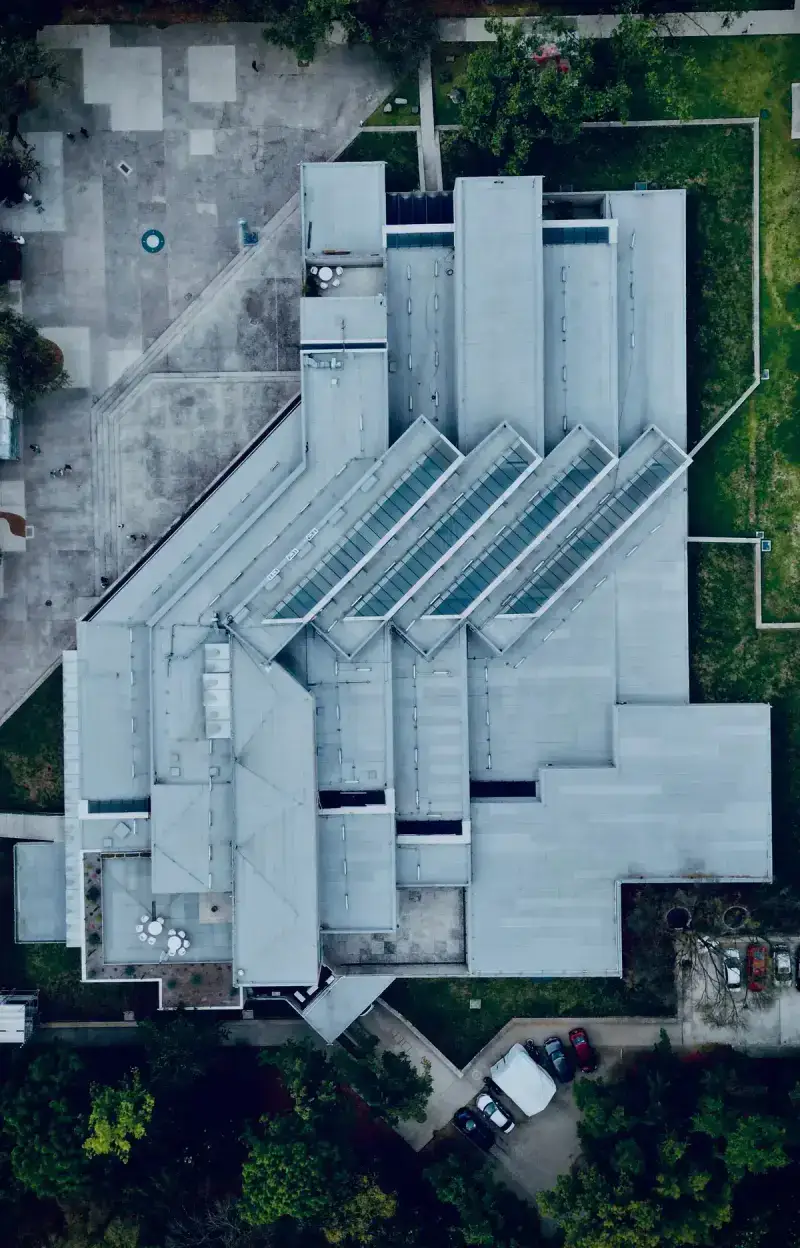
Flat roofs show up on mid-century moderns, additions, porches, and commercial-style sections of DFW homes — and they play by different rules than pitched roofs. Shingles rely on gravity to shed water fast; on a low slope, water lingers, so the roofing has to be a continuous waterproof membrane with sealed seams.
The common systems are TPO (a white single-ply membrane, heat-welded at the seams), modified bitumen (asphalt-based rolls, torched or adhered), and older built-up or EPDM rubber. What matters most is not the acronym — it is the details: seams sealed properly, flashing terminated correctly at walls and penetrations, and positive drainage so water never sits. Ponding water that stands for days after rain is the clearest sign a flat roof is in trouble.
SummitCrest Roofing is a free referral service — we don't install flat roofs ourselves. Describe your flat or low-slope section and we'll connect you with up to three independent local roofing professionals experienced with membrane systems. SummitCrest Roofing connects you with an independent local roofing professional — you work directly with the roofer you choose.
Key facts
- Low-slope roof sections need continuous waterproof membranes — TPO or modified bitumen — because shingles cannot shed water on a nearly flat surface.
- TPO is a white single-ply membrane with heat-welded seams; modified bitumen is asphalt-based rolls, torched or adhered.
- Drainage decides a flat roof's lifespan: water still ponding days after rain signals a drainage problem.
- The critical details are sealed seams, flashing terminations at walls and penetrations, and positive slope toward drains.
- Keep drains, scuppers, and gutters clear — standing water is the main enemy of flat roofs.
- Coating over a failing membrane without fixing drainage or seams is not a lasting repair.
- Typical first step
- Document what you see from the ground — missing shingles, ceiling stains, granules in the gutters — then get a pro out before the next rain.
- Emergency capable
- For active emergencies, call and we'll route you immediately.
Warning signs
Signs you need this service
- Water ponding on the flat section days after rain.
- Blisters, bubbles, or alligator-cracking in the membrane surface.
- Seams lifting or flashing pulling away at walls and penetrations.
- Leaks under the flat section — often at drains, scuppers, or wall flashing.
- An aging built-up or modified bitumen roof past its service life.
- Plans for rooftop equipment (HVAC, solar) that will sit on the membrane.
What happens
The process, step by step
Drainage assessment: the roofer checks slope, drains, and scuppers — ponding areas are mapped.
System selection: TPO, modified bitumen, or another membrane is matched to the structure and use.
Surface prep: the old membrane is repaired or removed, and the substrate is made sound and dry.
Installation: the new membrane goes down with sealed seams, proper flashing terminations, and verified drainage.
Watch
See this work up close
Commercial roofing overview
Illustrative stock footage — not SummitCrest's own work.
Cost factors
What influences the cost
Every job is different, so we won't quote prices sight unseen. These are the factors a pro will weigh when pricing your job:
- Membrane system chosen — TPO, modified bitumen, and other systems sit at different tiers.
- Whether the old system is removed or the new membrane goes over it.
- Drainage corrections — adding slope or drains is real work but prevents repeat failures.
- Flashing complexity at walls, penetrations, and rooftop equipment.
- Insulation upgrades often bundled with a flat roof replacement.
DIY guidance
What you can do — and when to stop
Safe to do yourself
- Keep drains, scuppers, and gutters clear — standing water is the enemy.
- Photograph ponding areas after rain so the roofer can see the drainage pattern.
- Trim overhanging branches that drop debris onto the membrane.
- Note where leaks appear inside relative to roof features.
Stop and call a pro
- Coating over a failing membrane as a 'fix' without addressing drainage or seams.
- Walking on the membrane carelessly — punctures from tools and debris cause leaks.
- Sealing a drain or scupper to 'stop a leak' — trapped water is worse.
- Installing rooftop equipment without proper membrane-compatible mounting.
Frequently asked questions
It depends on the system, installation quality, and drainage — well-installed membranes with good drainage typically last a couple of decades, while ponding water and neglected seams shorten that considerably. Ask the roofer what lifespan they expect from the specific system they install.
Not below the manufacturer's minimum slope — shingles on too-flat a roof will leak because water doesn't shed fast enough. Low-slope sections need membrane systems. A roofer can tell you where your roof crosses that line.
No. SummitCrest Roofing is a free referral service. We connect you with up to three independent local roofing professionals, and you work directly with the roofer you choose.
Insufficient slope, sagging structure, or clogged drains and scuppers. Some ponding right after rain is normal; water still standing after a day or two signals a drainage problem worth fixing before the membrane deteriorates.
The common ones: TPO and PVC single-ply membranes — white, heat-welded sheets popular on commercial and some residential roofs — EPDM rubber, and modified bitumen, a layered asphalt system. Each has different lifespans and maintenance needs. A roofer can recommend which suits your roof's slope and foot traffic.
Multiple or recurring leaks, widespread blistering or cracking, seams pulling apart, and ponding that drainage fixes can't solve. If repairs keep failing in new spots, the membrane is done. A roofer's core sample or moisture survey shows whether water has saturated the insulation underneath.
Clear drains, scuppers, and gutters at least twice a year — clogged drainage is the top killer of flat roofs. Remove debris, check seams and flashing for gaps, and look for new ponding after heavy rain. Keep foot traffic minimal and never drag equipment across the membrane. Schedule a pro inspection annually.
The old system comes off, the deck is inspected and repaired, then insulation boards go down followed by the membrane — heat-welded for TPO/PVC, adhered or mechanically fastened for others. Seams, edges, and penetrations get detailed flashing. Proper slope to drains is built in during this stage, not after.
The membrane system chosen, roof size and access, insulation thickness, how many drains and penetrations need detailing, and whether the old system must be torn off. Tapered insulation to fix ponding adds cost but solves the drainage problem. Complex parapet and curb flashing drives labor up.
Yes, it's done — usually by framing a pitched structure over the existing flat roof — but it's a significant construction project, not just a roofing job. It needs engineering, permits, and changes to drainage and possibly the facade. For most owners, a well-detailed membrane replacement is the more practical fix.
Towns we serve in DFW
Flat Roofs by city
- Allen, TX
- Dallas, TX
- Frisco, TX
- Irving, TX
- Plano, TX
- Arlington, TX
- Denton, TX
- Garland, TX
- Lewisville, TX
- Richardson, TX
- Carrollton, TX
- Flower Mound, TX
- Grand Prairie, TX
- Mckinney, TX
- Coppell, TX
- Fort Worth, TX
- Grapevine, TX
- Mesquite, TX
- The Colony, TX
- Keller, TX
- Southlake, TX
- Colleyville, TX
- Bedford, TX
- Euless, TX
- Hurst, TX
- North Richland Hills, TX
- Mansfield, TX
- Cedar Hill, TX
- Desoto, TX
- Rowlett, TX
- Rockwall, TX
- Addison, TX
- Wylie, TX