
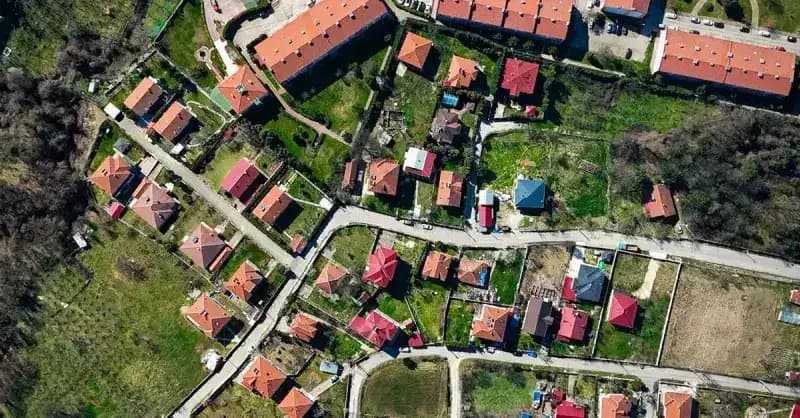
Carrollton's Josey Ranch and the 1970s–80s subdivisions are textbook DFW middle suburbia — and their roofs are textbook middle-aged. Builder-grade shingles from the boom decades are now well into their later years across whole neighborhoods, with granule loss and curling arriving on schedule.
The commercial corridors add a local wrinkle: flat and low-slope sections on mixed-use buildings that need membrane attention, not shingles. And Historic Downtown Carrollton's older homes carry smaller, simpler roofs where a straightforward replacement goes a long way.
Hail season treats Carrollton like the rest of the metro — the spring storm track doesn't skip the middle suburbs. Brittle aging shingles plus hail is the combination that ends roofs, which is why the inspection habit matters most on roofs over 15.
Historic downtown Carrollton's brick streets are lined with early-1900s homes — small, steep-roofed, and characterful — while the bulk of the city is 1970s–90s subdivisions built during the DFW boom. The Trinity Mills corridor and the DART rail line shaped growth here, and the housing stock's middle age means replacement decisions are landing in waves across neighborhoods.
When roof trouble hits your Carrollton home — an aging Josey Ranch roof, hail damage, or a flat section needing membrane work — SummitCrest Roofing connects you with independent local roofing professionals. Tell us what is happening and we will match you with a pro nearby, fast.
- County
- Dallas County
- ZIP codes
- 75006, 75007, 75010, 75011
- Service area
- Carrollton, Texas
Carrollton
Homes here, and the roofing problems they get
Local housing notes
- Josey Ranch and 1970s–80s subdivisions: builder-grade shingles in late life.
- Historic Downtown Carrollton: older, smaller homes with simpler roofs.
- Hebron and Nob Hill: mixed ages, many mid-life roofs.
- Commercial corridors: flat/low-slope sections needing membrane systems.
- Whole-neighborhood roof aging is the visible pattern.
- Downtown historic homes: steep pitches, original or second roofs, flashing details that demand real craftsmanship. 1970s–90s subdivisions: builder-grade shingles reaching end of typical lifespan in clusters.
Common local roofing issues
- Late-life builder-grade shingles across 1970s–80s subdivisions.
- Hail on brittle aging roofs.
- Flat/low-slope membrane aging on commercial-style buildings.
- Granule loss clogging gutters.
- Flashing wear at penetrations on mid-life roofs.
Common calls in Carrollton
Carrollton FAQs
Very likely past its service life — 1980s shingles are 35–45 years old, well beyond typical lifespan. If it's not leaking, consider yourself lucky and plan the replacement now, on your schedule, before a storm makes the decision for you.
A roofer experienced with membrane systems (TPO, modified bitumen) — it's a different craft than shingles. Make sure whoever you hire does flat work regularly, not as an occasional sideline.